Record, Recite & Memorize
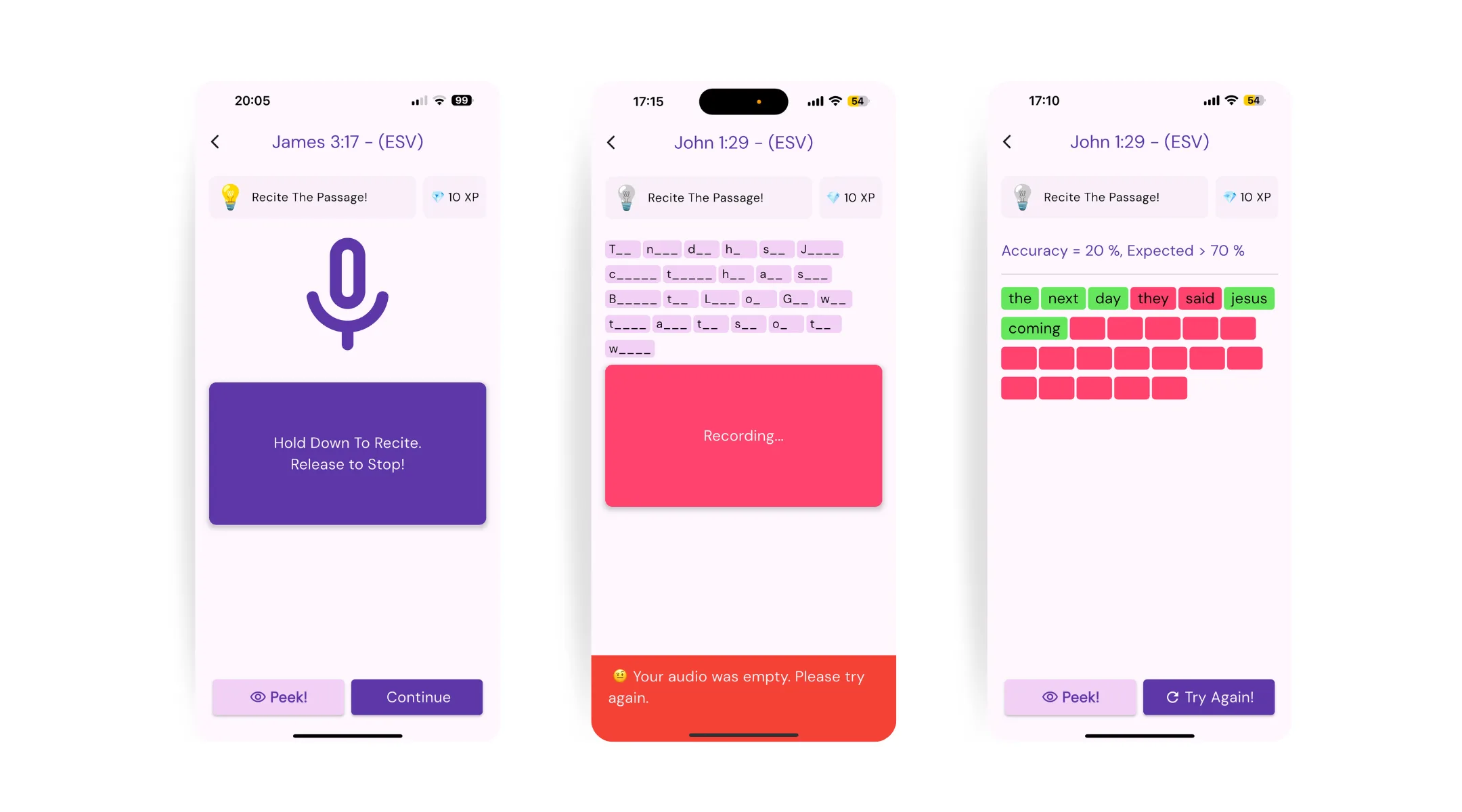
We are thrilled to introduce a powerful new lesson type in HideTheWord: Recite the Passage! This feature takes your Scripture memory journey to the next level by letting you record yourself reciting verses while AI measures your accuracy.
Reciting Scripture aloud is one of the most effective ways to lock God's Word into your long-term memory. Research has consistently shown that speaking words aloud creates a powerful memory advantage over reading silently. Scientists call this the "production effect," and it is one of the most well-documented phenomena in memory research.
How It Works
Using Recite the Passage is simple.
Record Yourself. Speak the verse out loud, just as you have memorized it. If you need a little help, the lesson offers first-letter hints for each word to guide you. The hints appear as the first letter of each word in the verse, giving you just enough support to keep going without giving away the entire verse.
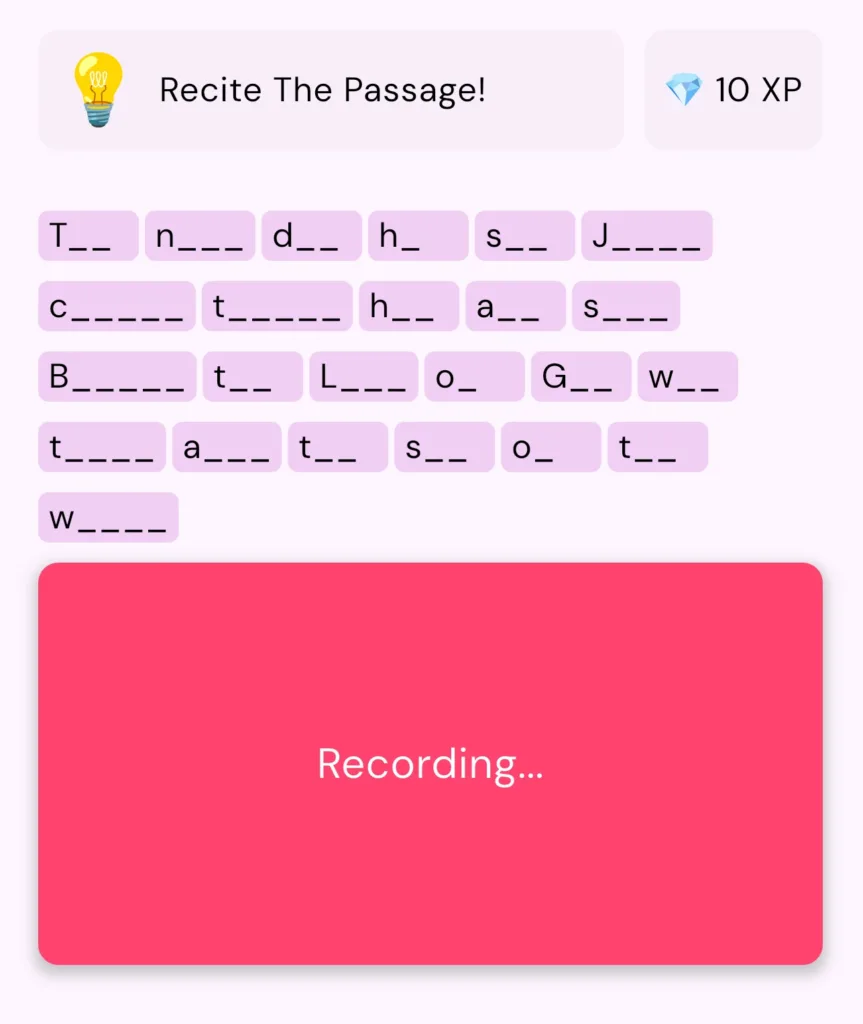
AI Measures the Accuracy. As you speak, HideTheWord's AI listens and compares your recitation to the original verse. It analyzes each word, checking for accuracy, word order, and completeness.
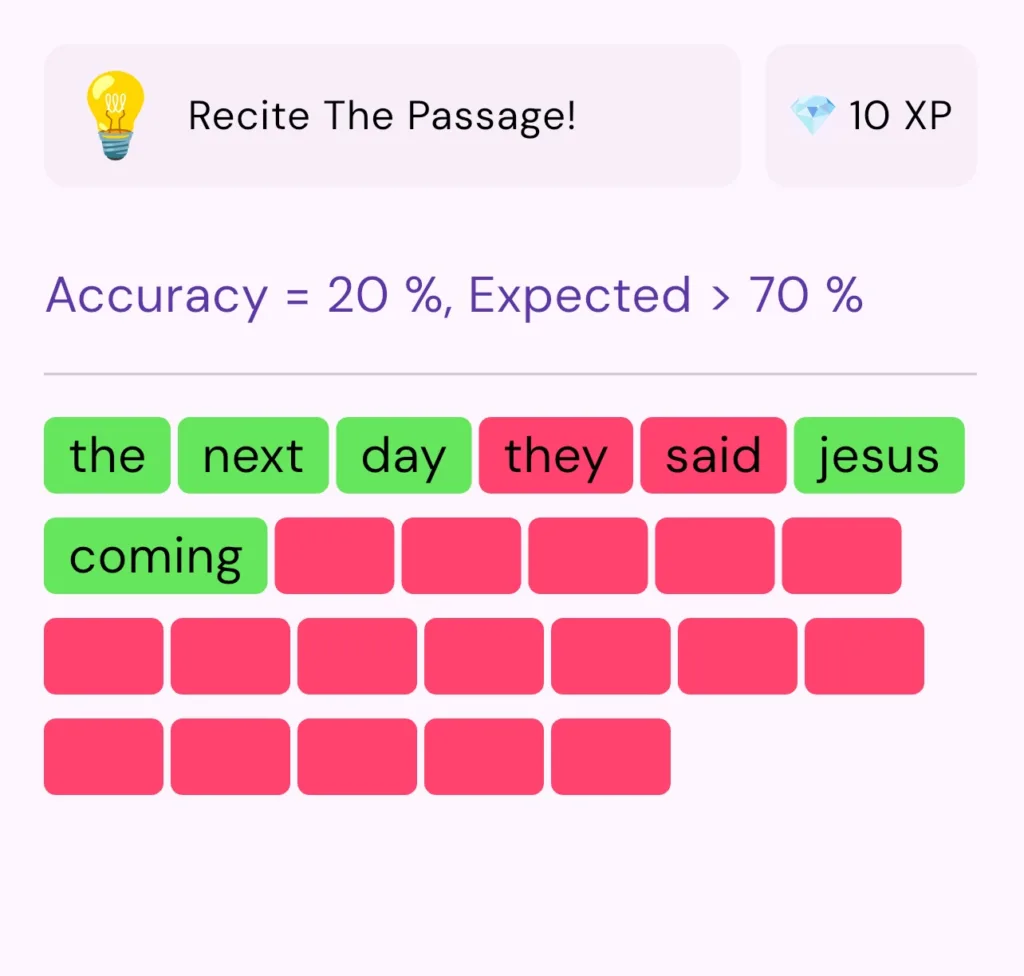
Instant Feedback. The moment you finish, you get your results. The AI shows you exactly which words you got right and where you stumbled. This focused feedback helps you target your practice on the parts you still need to work on.
Why Recite Out Loud?
There are several reasons why reciting Scripture aloud is so powerful.
The Production Effect. Memory researchers have studied the production effect for decades. The finding is remarkably consistent: people remember words they read aloud far better than words they read silently. A comprehensive study published in the journal Memory & Cognition found that reading aloud significantly improved memory for text passages, with the effect being strongest for verbatim recall. When you speak a verse out loud, your brain engages motor planning, articulation, and auditory processing. This creates a richer, more distinctive memory trace.
Motor Memory. Your body remembers what your mouth does. When you recite a verse aloud repeatedly, the physical act of speaking becomes part of your memory of that verse. This is why you can still recite nursery rhymes you learned as a child. Your body remembers the rhythm and the movements of your mouth even if you have not thought about the words in years.
Auditory Reinforcement. When you hear your own voice speaking Scripture, it creates a second memory pathway. You remember not just the words on the page, but the sound of your own voice saying them. This dual encoding makes the memory far more durable.
Confidence Building. Reciting a verse aloud from memory proves to yourself that you truly know it. There is a difference between recognizing a verse when you read it and being able to produce it from memory. The confidence that comes from knowing you can recall Scripture anytime, anywhere is invaluable.
Spiritual Readiness. When you practice reciting Scripture aloud, you are preparing yourself for real-life situations where you might need to speak God's Word. Whether it is encouraging a friend, sharing the gospel, or resisting temptation, the ability to speak Scripture from memory is a powerful tool.
The Science Behind It
The production effect has been replicated in dozens of studies since it was first documented. Here is what the research shows:
A study from the University of Waterloo found that reading words aloud led to significantly better recognition memory than reading silently. The effect was so consistent that the researchers described it as "a simple but powerful way to improve memory."
Another study published in Psychonomic Bulletin & Review found that the production effect was even stronger when people heard their own voice compared to hearing someone else speak the words. This means that reciting Scripture aloud yourself is more effective than simply listening to someone else read it.
These findings have real implications for Scripture memory. Silent reading is useful for understanding and reflection. But if your goal is to lock a verse into long-term memory so you can recall it anytime, reciting aloud is essential.
Recitation has been used for thousands of years across cultures as a primary tool for learning and memory. Ancient Jewish education relied heavily on oral recitation. The Hebrew word for "meditate" in Joshua 1:8 literally means "to mutter" or "to speak to oneself." God's instruction to Joshua was not just to think about the Law silently, but to speak it aloud.
How To Get Started
Using the Recite feature is easy:
- Open a lesson for any verse in your library.
- Look for the "Recite" option in your lesson types.
- Tap the microphone button and begin speaking the verse from memory.
- Use first-letter hints if you get stuck.
- Review your accuracy results and celebrate your progress.
Tips For Better Recitation
Speak clearly. The AI is good, but it works best when you speak at a normal pace with clear pronunciation.
Do not rush. Take your time. It is better to recite slowly and accurately than quickly and sloppily.
Use the first-letter hints. If you get stuck, glance at the hints. The goal is to build your memory, not to test yourself without any support.
Repeat often. Recite the same verse multiple times over several days. Each recitation strengthens the memory.
Recite in different settings. Try reciting while walking, while doing dishes, or while driving. Varying the context makes the memory more flexible and accessible.
Try It Today
Reciting Scripture aloud deepens your memory and builds confidence in recalling verses anytime you need them. The new Recite the Passage feature in HideTheWord makes this powerful practice easy and gives you instant feedback on your progress.
Try the new Recite feature today and see how it transforms your Scripture memory experience with HideTheWord.